

Discover what epigenetic stress and dysfunctional adaptation mean: how the nervous system can get ‘stuck’ in a chronic stress response and what this means for your health. A scientific insight from REAC Technology.
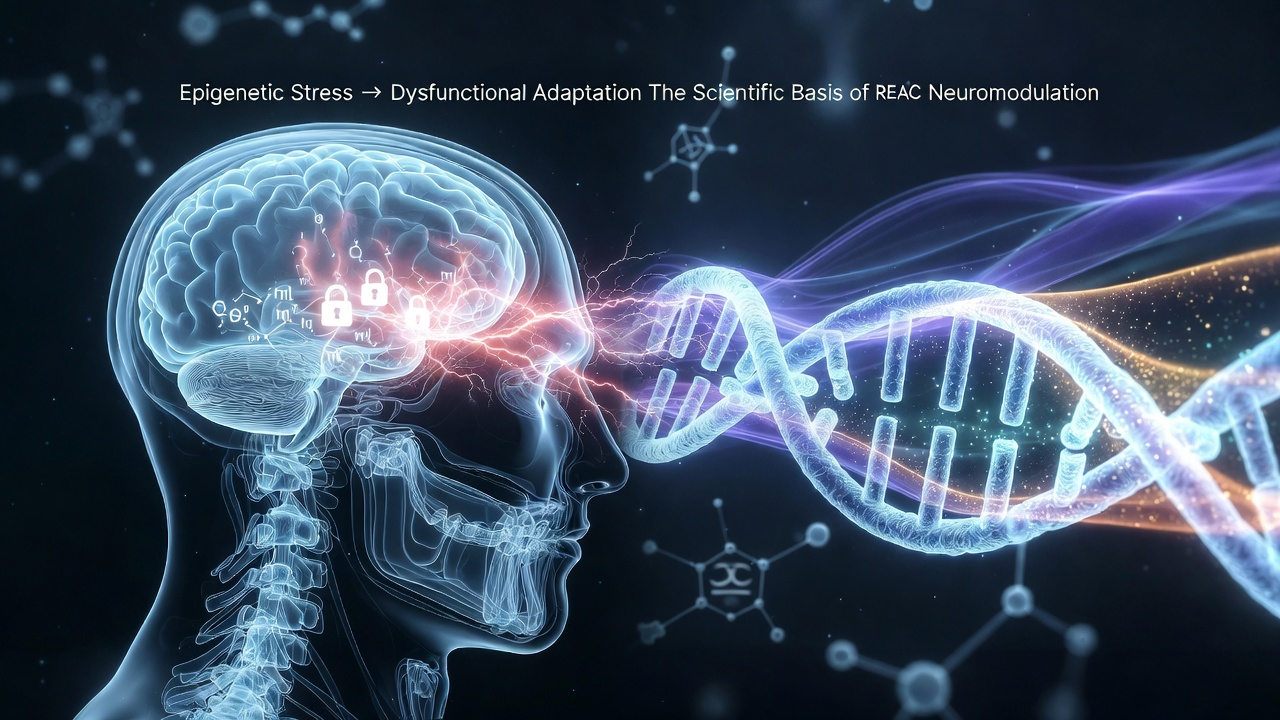
To understand the rationale behind REAC neuromodulation protocols, two foundational concepts must be clearly defined: epigenetic stress and dysfunctional adaptation. Grasping these ideas means understanding why the boundary between wellness and disease is often far more nuanced than commonly assumed.
Contrary to widespread perception, stress is not inherently a pathology. It is a natural physiological response activated whenever the organism encounters change: an intense emotion, a trauma, an infection, an inflammatory process, or an environmental challenge.
The nervous system acts as an ‘orchestra conductor’: coordinating movement, posture, heart rate, hormonal balance, immune response, and emotional processing. Its core function is to maintain homeostasis — the dynamic equilibrium of the organism.
Problems arise when the stressful stimulus is excessively intense, prolonged, or repetitive over time. Under these conditions, the nervous system may ‘stabilize’ in an altered functional mode, losing the ability to return spontaneously to balance.
This is what is defined as dysfunctional adaptation: the organism continues to react as if the stressor were still present, even in its absence. The most frequent clinical manifestations include:
• Sleep disorders and insomnia
• Persistent muscle tension
• Postural alterations
• Mood disturbances (anxiety, irritability, depressive states)
• Low-grade chronic inflammation
• Hormonal imbalances
• Metabolic dysfunctions
The term ‘epigenetic’ refers to modifications that alter gene expression without mutating the DNA sequence. Experiences, environmental factors, and stressors can act on the mechanisms that regulate genome reading, influencing how cells express their biological potential.
It is not the gene that changes, but the way it is ‘read’ and translated into cellular function. This explains why individuals with identical genetic backgrounds may display very different biological responses and health profiles.
There exists a phase — often clinically underestimated — in which the body has already departed from optimal functioning without yet manifesting a diagnosed pathology. This is the phase of dysfunctional adaptation, which REAC technology aims to identify and treat early.To detect this subclinical condition, research at the Rinaldi Fontani Institute has introduced an innovative parameter: fluctuating asymmetry. This concept will be explored in the next contribution.

Dr. Vania Fontani MD, PhD, is a prominent figure in the field of regenerative medicine and neurobiological modulation.
She has dedicated her career to research and the development of innovative technologies for human well-being.
Currently, Dr. Fontani holds the position of Scientific Director at the Rinaldi Fontani Institute in Florence, where she leads the Department of Regenerative Medicine.
In collaboration with Prof. Salvatore Rinaldi, she co-developed the REAC® (Radio Electric Asymmetric Conveyer) technology, a non-invasive methodology aimed at modulating endogenous bioelectric activity to promote health and well-being.
Her research work is documented in over 60 scientific publications, with a significant impact in the field of neuromodulation and regenerative medicine.
Her experience and expertise make her an ideal speaker for international events focused on innovation and longevity
Learn more:
• Publications: PubMed – Rinaldi S, Fontani V

Physician and researcher, pioneer in neurobiological modulation, regenerative medicine, and anti-senescence therapies Scientific Director – Rinaldi Fontani Institute, Florence, Italy
ORCID: 0000-0002-8961-6316
Profile and Mission
Salvatore Rinaldi is an internationally recognized innovator for his groundbreaking
contribution to the study and clinical application of neurobiological modulation using
asymmetrically conveyed radio-electric signals (REAC). His work has redefined the
boundaries of regenerative medicine and longevity, demonstrating how optimizing
endogenous bioelectrical activity can promote cellular reprogramming, recovery of
compromised functions, and the prevention of age-related decline.
Research Milestones
Rinaldi’s research has opened new frontiers in the understanding and treatment of
neurodegenerative diseases and cellular aging processes. Among his most significant
contributions:
Regenerative Medicine:
Anti-Senescence and Longevity:
Neurodegenerative Diseases – Efficacy of REAC Technology in Alzheimer’s and
Neurodegeneration Models:
Scientific Vision
Salvatore Rinaldi’s work demonstrates that bioelectrical modulation is not merely a
theoretical concept, but a concrete and reproducible therapeutic strategy to counteract
aging, support cellular repair processes, and prevent tissue degeneration.
Learn more:
• ORCID Profile: 0000-0002-8961-6316
• Publications: PubMed – Rinaldi S, Fontani V