

Learn how functional dysmetria and fluctuating asymmetries reveal nervous system overload. Scientific insights from Rinaldi-Fontani & REAC Technology.
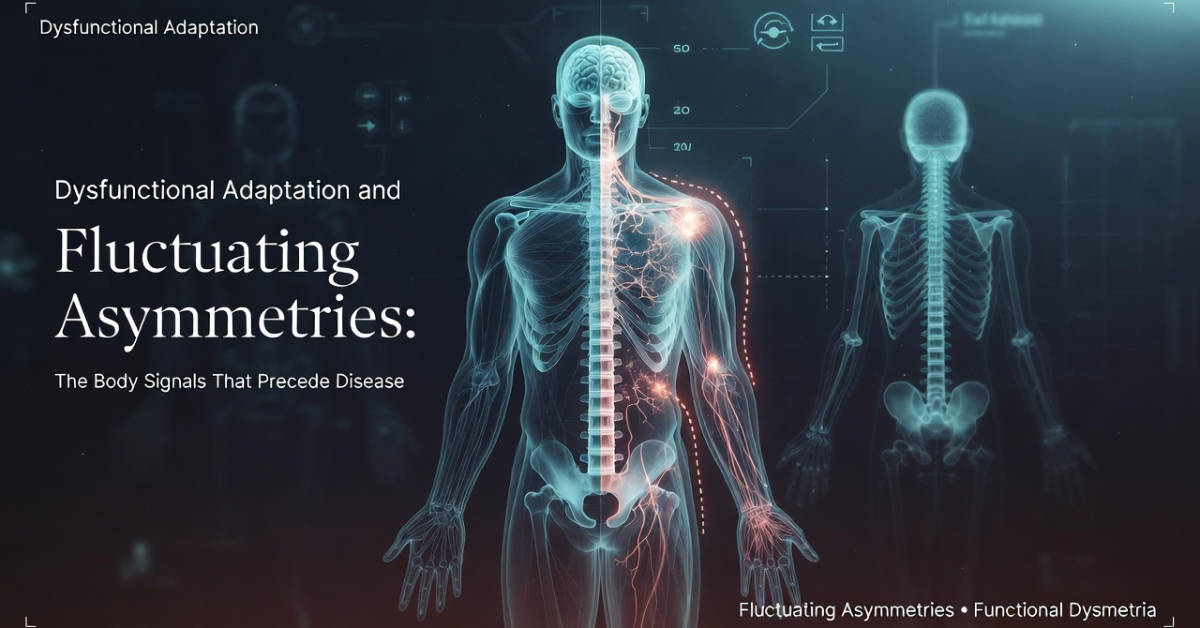
Understanding the disorders typical of modern life requires an integrated reading of the organism. When the nervous system fails to complete the adaptive cycle in response to stress, it leaves concrete traces in the way the body moves, organizes itself in space, and maintains balance. These signals — defined as fluctuating asymmetries — represent one of the key indicators used by REAC® technology to identify adaptive overload states at an early stage.
Every time the organism faces a demanding situation, it activates a precise and hierarchical sequence of reactions. In chronological order: automatic functions are modified (heart rate, breathing, muscle tone); movement patterns and postural attitude change; behaviors are altered; and only in the final stage is the psychological and emotional sphere engaged.
This progression is a survival mechanism whose goal is to overcome the challenge and restore homeostasis. However, when the system fails to ‘switch off the alarm’, the adaptive modifications become consolidated over time, giving rise to what is defined as dysfunctional adaptation.
Dysfunctional adaptation is not exclusively a psychological phenomenon. It simultaneously involves muscle tone, posture, hormonal regulation, immune response, and motor coordination. The nervous system, as the integration center between the organism and the environment, is the first to manifest these alterations.
Since emotions and psychological states are inherently subjective and difficult to quantify, research at the Rinaldi Fontani Institute developed an alternative approach: observing how the body moves and organizes itself in space. It is in this context that the concept of fluctuating asymmetries emerges.
The human body is structured according to bilateral symmetry: the right and left halves should be substantially mirrored. When the regulatory system functions optimally, this symmetry is harmonious and movement is fluid and coordinated.
Fluctuating asymmetries are small discrepancies between the two sides of the body that do not have a genetic origin but are generated by stress and environmental pressures. They are not obvious deformities, but subtle signals indicating a reduced capacity of the nervous system to maintain balance and coordination. Evolutionary sciences document a direct correlation between symmetry and adaptive capacity: the appearance of asymmetries signals that the organism is encountering difficulty meeting environmental demands.
The plant analogy is illuminating: a plant exposed to irregular environmental conditions (wind, asymmetric light) grows in a non-perfectly symmetrical way as a survival strategy. Similarly, a human being under pressure may alter their functional organization at the cost of precision and original harmony.
From a clinical perspective, these asymmetries manifest as reduced precision and motor coordination a phenomenon defined in medicine as dysmetria. Classically, dysmetria is associated with cerebellar lesions. However, it can also be detected in individuals without established structural damage.
In these cases, Rinaldi and Fontani coined the term Functional Dysmetria: not a neurological lesion, but an altered motor behavior expressing adaptive overload. The organism continues to function, but with less precision and symmetry — an unequivocal signal that the regulatory system is operating at the limit of its capacity.
Early recognition of fluctuating asymmetries and functional dysmetria allows intervention before adaptive overload evolves into structured disorders. This is the clinical space in which REAC® Technology protocols find their primary indication. Upcoming contributions will address in detail how these mechanisms translate into clinical practice: specific therapeutic protocols, indications, and application methods across different fields.

Dr. Vania Fontani MD, PhD, is a prominent figure in the field of regenerative medicine and neurobiological modulation.
She has dedicated her career to research and the development of innovative technologies for human well-being.
Currently, Dr. Fontani holds the position of Scientific Director at the Rinaldi Fontani Institute in Florence, where she leads the Department of Regenerative Medicine.
In collaboration with Prof. Salvatore Rinaldi, she co-developed the REAC® (Radio Electric Asymmetric Conveyer) technology, a non-invasive methodology aimed at modulating endogenous bioelectric activity to promote health and well-being.
Her research work is documented in over 60 scientific publications, with a significant impact in the field of neuromodulation and regenerative medicine.
Her experience and expertise make her an ideal speaker for international events focused on innovation and longevity
Learn more:
• Publications: PubMed – Rinaldi S, Fontani V

Physician and researcher, pioneer in neurobiological modulation, regenerative medicine, and anti-senescence therapies Scientific Director – Rinaldi Fontani Institute, Florence, Italy
ORCID: 0000-0002-8961-6316
Profile and Mission
Salvatore Rinaldi is an internationally recognized innovator for his groundbreaking
contribution to the study and clinical application of neurobiological modulation using
asymmetrically conveyed radio-electric signals (REAC). His work has redefined the
boundaries of regenerative medicine and longevity, demonstrating how optimizing
endogenous bioelectrical activity can promote cellular reprogramming, recovery of
compromised functions, and the prevention of age-related decline.
Research Milestones
Rinaldi’s research has opened new frontiers in the understanding and treatment of
neurodegenerative diseases and cellular aging processes. Among his most significant
contributions:
Regenerative Medicine:
Anti-Senescence and Longevity:
Neurodegenerative Diseases – Efficacy of REAC Technology in Alzheimer’s and
Neurodegeneration Models:
Scientific Vision
Salvatore Rinaldi’s work demonstrates that bioelectrical modulation is not merely a
theoretical concept, but a concrete and reproducible therapeutic strategy to counteract
aging, support cellular repair processes, and prevent tissue degeneration.
Learn more:
• ORCID Profile: 0000-0002-8961-6316
• Publications: PubMed – Rinaldi S, Fontani V